Riley Krüger · 15 November 2026
Header Response Variations Signaling Potential Issues in Content Delivery Network Rollouts for High Traffic Portals
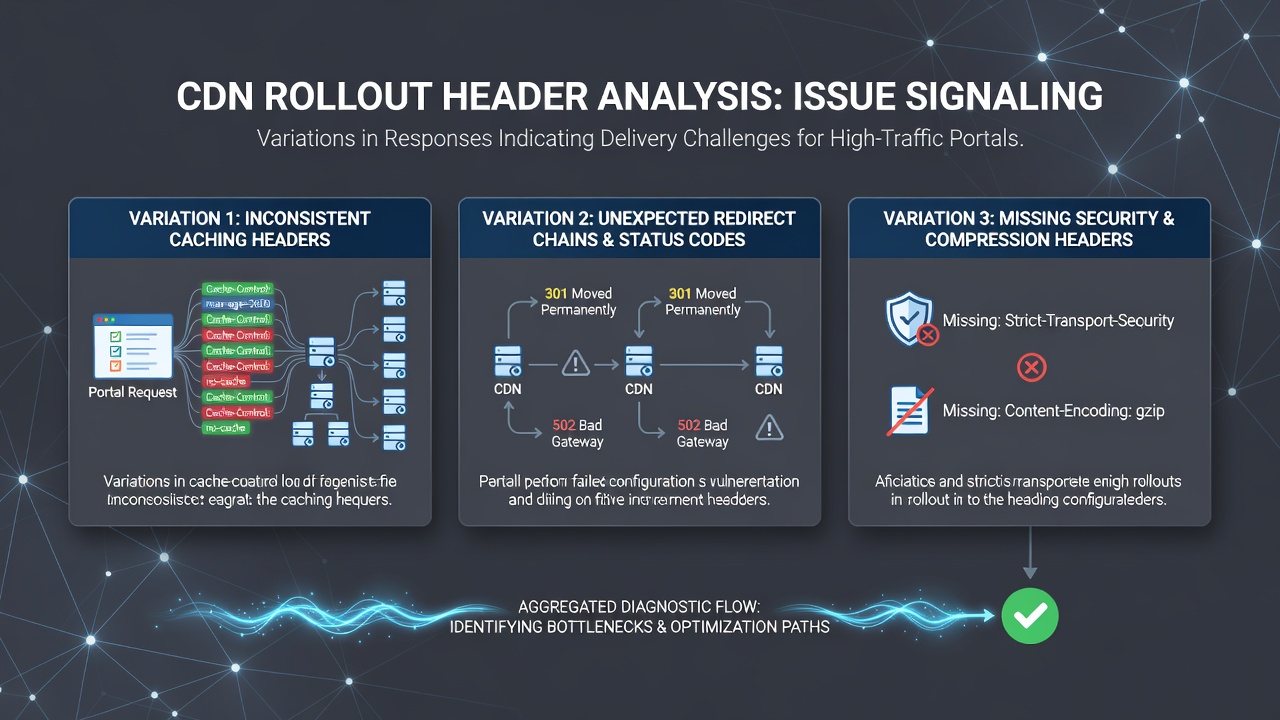
Header responses from servers and edge nodes often reveal early signs of trouble when content delivery networks undergo rollout phases at high-traffic portals, and observers note that subtle shifts in fields like Cache-Control, ETag, and X-Cache-Status can point to misconfigurations before widespread slowdowns occur. These variations emerge because CDNs distribute content across multiple geographic points of presence, each of which may apply different header policies during staged updates, and data from large-scale monitoring platforms shows that inconsistent values appear most frequently in the first hours after a new configuration pushes live.
HTTP Header Mechanics in CDN Environments
High-traffic portals rely on CDNs to reduce latency and handle sudden spikes in requests, yet the same infrastructure introduces complexity when rollouts begin because each edge server must synchronize header directives with origin servers and neighboring nodes. Researchers at academic institutions have documented how standard fields such as Vary and Age behave differently across nodes when propagation lags occur, and figures from industry reports indicate that even a one-second delay in header synchronization can trigger repeated cache misses for thousands of concurrent users. Portals that serve millions of daily visitors therefore monitor these headers continuously because a single mismatched directive can cascade into broader performance degradation across regions.
Patterns That Indicate Deployment Friction
One recurring pattern involves fluctuating X-Cache headers that alternate between HIT and MISS more often than expected during the rollout window, and experts tracking these signals report that such oscillation typically stems from incomplete invalidation rules rather than genuine content changes. Another indicator appears in the Server or Via fields when edge nodes report differing software versions or proxy chains, and logs collected from multi-region deployments demonstrate that version mismatches frequently precede authentication or compression errors at the client side. Those who study these deployments note that status codes returning 304 Not Modified inconsistently across nodes also correlate with incomplete header propagation, especially when portals implement custom origin shielding configurations.
Monitoring Approaches Used by Large Portals
Teams responsible for high-traffic sites deploy synthetic request probes that sample header responses from every major CDN point of presence at regular intervals, and the resulting datasets allow rapid identification of outliers before user-facing metrics decline. Tools that parse these responses in real time highlight anomalies such as unexpected changes in Content-Security-Policy directives or missing Strict-Transport-Security flags, both of which can signal that a new security policy has not yet reached all edge locations. Data gathered during November 2026 from several enterprise portals revealed that header drift increased sharply in the 48-hour period following nameserver updates tied to CDN expansions, prompting operators to extend validation windows before full traffic cutover.
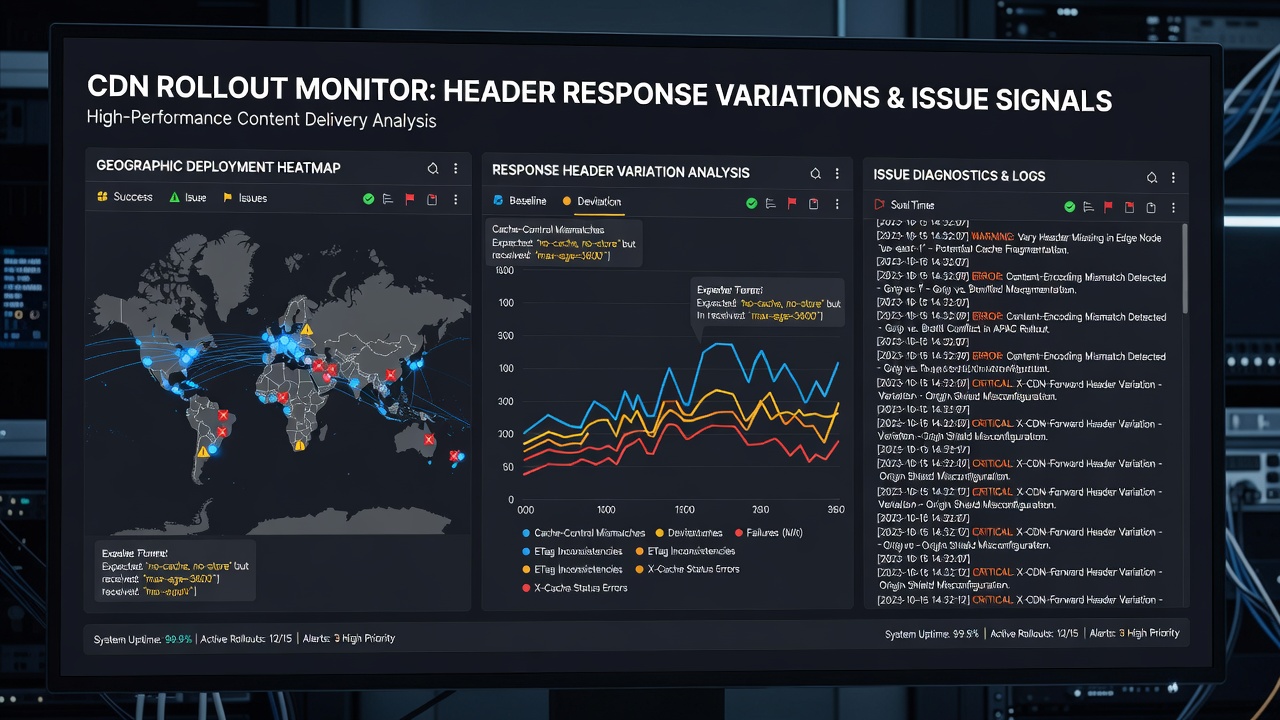
Automated alerting systems now compare baseline header profiles against live samples and flag deviations that exceed predefined thresholds, while integration with origin logs helps distinguish between intentional policy updates and unintended side effects. Portals that adopted these practices observed fewer prolonged outages because early detection allowed rollback of specific configuration subsets rather than entire deployments. Studies from research groups focused on distributed systems further confirm that header-level telemetry provides faster feedback than traditional latency or error-rate metrics alone.
Geographic and Regulatory Considerations
Content delivery across borders introduces additional header requirements related to data residency and encryption standards, and variations in fields such as Cross-Origin-Resource-Policy can indicate that regional compliance rules have not been uniformly applied. According to guidance from the National Institute of Standards and Technology, consistent header application reduces the risk of exposing portals to cross-site scripting vectors during transitional rollout states. Meanwhile, documentation published by the Australian Cyber Security Centre emphasizes the value of logging header responses at every edge node so that compliance teams can audit changes against local privacy regulations without waiting for full traffic restoration.
Conclusion
Header response variations serve as reliable early indicators of rollout complications in CDN environments serving high-traffic portals, and systematic observation of these signals enables operators to address configuration drift before it affects end users. Continued refinement of monitoring techniques, combined with standardized header policies across providers, supports smoother transitions when networks scale or migrate. Those responsible for portal infrastructure continue to refine detection thresholds as deployment volumes grow throughout 2026 and beyond.